India has over 600,000 medical representatives competing for the attention of roughly 1.3 million doctors. That is nearly one MR for every two doctors in the country. In this environment, success is rarely about visiting more doctors. It is about visiting the right doctors, with the right message, at the right time — and having the tools to make that happen consistently, territory after territory, month after month.
01. The scale of the challenge — India's pharma battlefield
No other country in the world has a pharmaceutical field force quite like India's. With over 600,000 MRs active across the country, the competition for a doctor's attention — and ultimately their prescription pad — is intense in a way that is difficult to overstate.
A typical doctor in a busy urban clinic may receive visits from 5 to 10 different MRs in a single day. Every one of them is carrying a product they believe is better. Every one of them has a monthly target. And every one of them has roughly the same amount of time — often less than five minutes — to make their case.
In this environment, the MRs who win are not necessarily the ones who work the hardest. They are the ones who work the smartest — who know which doctors to prioritise, what to say when they get there, and how to use data to stay one step ahead of the competition.
"In India, it is not about seeing more doctors. Every MR is already seeing 10 a day. It is about seeing the right doctors — the ones who will actually move the prescription needle."
02. How an Indian pharma territory actually works
Before understanding how MRs increase prescriptions, it helps to understand the operational reality they work within. Indian pharmaceutical companies have developed one of the most structured field force systems in the world — built around a concept called the Daily Call Average (DCA).
The standard Indian territory breakdown
Major Indian pharma companies including Sun Pharma, Cipla and Mankind have standardised their field force operations around the following model:
- Master List: 150–180 doctors for General/Acute segments (GPs, Paediatricians, Physicians)
- Daily Call Average (DCA): 10–12 doctor visits per day, across 25 working days per month
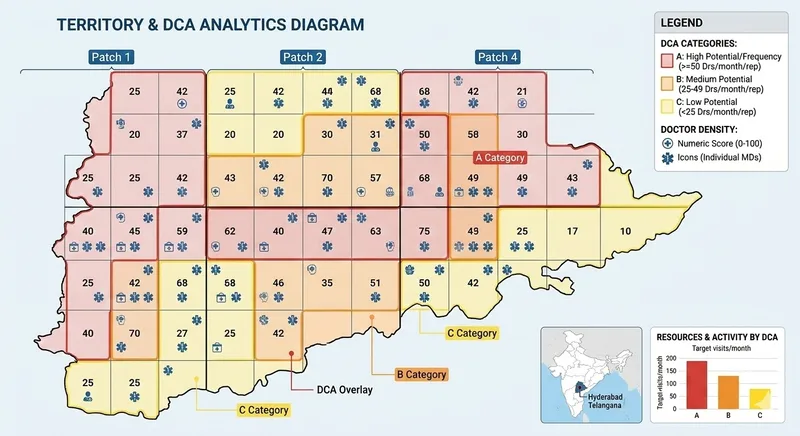
- Monthly coverage: The full list is covered once per month, with top "A-category" doctors receiving a visit or two more
- The 15-Day Rule: Top 50–60 "A-category" or "Core" doctors must be visited within the first 15 days of the month
- Chemist visits: 5–10 retail chemists per day for RCPA data collection
- Stockist visits: 2–4 stockists per territory to ensure product availability
The territory is further divided into geographic sub-areas called Patches — typically 15 to 20 per territory, each containing 8 to 15 doctors within a 2 to 5 kilometre radius. An MR covers one Patch per day, minimising travel time and maximising face time with doctors. The structure of a Patch determines how efficiently an MR can work. But what happens within each Patch — which doctors to prioritise, what message to deliver, what the RCPA data shows — is where the real competitive battle is won or lost.
| Segment type | Master list size | Target doctors | Competition level |
|---|---|---|---|
| General / Acute (Antibiotics, Painkillers) | 180–200 doctors | GPs, Physicians | Very high |
| Specialty (Cardio, Diabetes, Neuro) | 100–120 doctors | Specialists, KOLs | High |
| Super-Specialty (Oncology, Nephrology) | 40–60 doctors | Super-specialists | Selective |
03. Quality vs. quantity — the relationship problem
Here is the uncomfortable truth that every field force manager in India knows: covering 150–200 doctors in a month means most doctors receive exactly one visit per month. That is not a relationship. That is a transaction.
One visit a month is enough to keep a brand name in circulation. It is not enough to build the kind of trust that changes prescription behaviour. And when you have 600,000 MRs all operating on the same DCA model, visiting the same doctors at the same frequency, the MR who simply "does the rounds" blends into the noise.
This is why the smartest pharma companies have moved away from treating all doctors equally. The answer is not fewer doctors — it is smarter prioritisation. Specifically:
- Gold-tier doctors (your top 50–60) get 2–3 visits per month — one in the first 15 days, and one or two more across the cycle. These are the doctors whose prescriptions drive the majority of your territory's revenue.
- Silver-tier doctors get one visit per month with a clear, focused message.
- Bronze-tier doctors are monitored via RCPA and moved up the priority list when the data shows they are writing competitor prescriptions that could be converted.
The tier names themselves — Gold, Silver, Bronze, or A, B, C, or any classification your company already uses — matter less than the discipline of applying them consistently and tracking visits against targets set for each tier.
The challenge is knowing which doctors belong in which category — and keeping that classification current as prescribing patterns shift. That requires data. Specifically, it requires RCPA data.
"The MR who visits 200 doctors equally will always be outperformed by the MR who visits 60 doctors strategically — with the right data behind every call."
04. Building trust-based doctor relationships
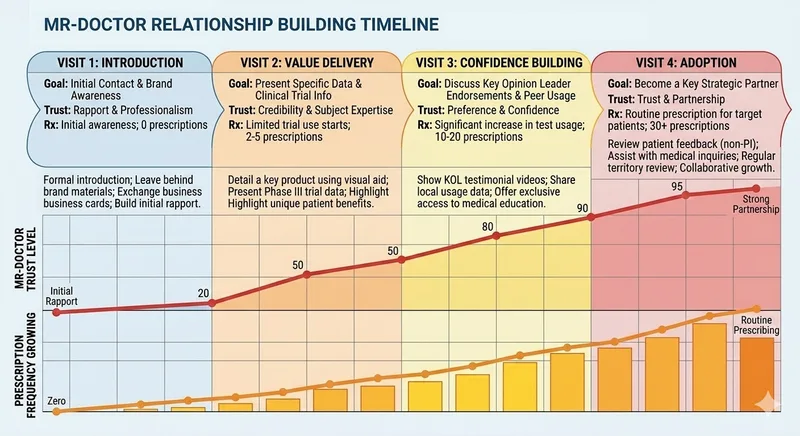
Despite the operational pressures of the DCA system, relationships remain the foundation of prescription growth. Doctors are busy, often sceptical, and constantly approached. The MRs who cut through are the ones who are genuinely useful — who bring relevant clinical information, respect the doctor's time, and show up consistently with something worth hearing.
The data backs this up. 84% of doctors see a pharma representative at least once a week, and 14% see them daily. Access is not the problem. Value is. The MR who becomes a trusted source of clinical information — rather than just another brand promoter — earns something no competitor can easily take away: a doctor's default preference.
05. Clinical knowledge that actually moves prescriptions
A doctor's time is among the most constrained resources in Indian healthcare. When an MR walks in, they often have three to five minutes — sometimes less. The MRs who make that time count arrive prepared with clear, clinical, and relevant product knowledge: what the drug treats, which patients benefit most, why it is better than the alternatives, and what the safety profile looks like.
Research shows it typically takes 7 to 10 MR visits to meaningfully change a doctor's prescribing behaviour. That means every visit needs to build on the last — reinforcing the clinical message, updating the doctor on new evidence, and staying relevant to the cases they are actually seeing. The MR who comes in with the same pitch every month is wasting the visit. The MR who comes in with something new and useful is investing in a relationship.
06. The art of detailing — why digital changes everything
Detailing — the structured presentation of a product during a doctor visit — has always been the core of pharmaceutical field sales. Done well, a three-minute detail can shift a doctor's thinking in ways that no advertisement or brochure can. Done poorly, it is forgotten before the MR reaches the staircase.
Traditional detailing relied on printed visual aids and verbal pitches. Modern detailing is a different game. e-Detailing — digital, interactive product presentations delivered on a tablet — allows MRs to walk doctors through clinical evidence in a structured, memorable way, leave behind digital materials the doctor can revisit, and adapt the conversation in real time based on what the doctor responds to.
The market agrees: the global e-Detailing market is projected to grow from $830 million in 2022 to over $2.1 billion by 2030, driven by pharma companies recognising that digital engagement produces better outcomes than paper. Critically, a BCG survey found that 60% of doctors still prefer learning about new products through in-person visits — meaning e-Detailing is not a replacement for the MR, but a powerful tool in the MR's hands.

e-Detailing built for the Indian field force
Zoulte's e-Detailing tool gives your MRs everything they need to deliver compelling, brand-consistent presentations in every doctor interaction — on a tablet, in the field, in three minutes or thirty. No outdated printed materials. No inconsistent messaging. Just sharp, digital storytelling that sticks.
See Zoulte e-Detailing →07. RCPA — turning prescription data into competitive advantage
In the Indian pharma context, RCPA (Retail Chemist Prescription Audit) is not just a tool — it is the intelligence layer that separates strategic selling from guesswork. By visiting 5 to 10 retail chemists per day and tracking which prescriptions are being dispensed, an MR builds a real-time picture of exactly what each doctor in their territory is prescribing — and for which brands.
This data answers the most important questions in field sales: Which of my A-category doctors is writing competitor prescriptions? Which C-category doctor has just started writing in my therapy area and needs to be moved up the priority list? Which brand is gaining share in my patch — and why?
Without RCPA, an MR is visiting doctors based on habit and intuition. With RCPA, every visit is backed by evidence. The doctor who is already loyal gets a retention message. The doctor who is writing competitor brands gets a targeted conversion pitch. The result is a field force that works smarter, not just harder.
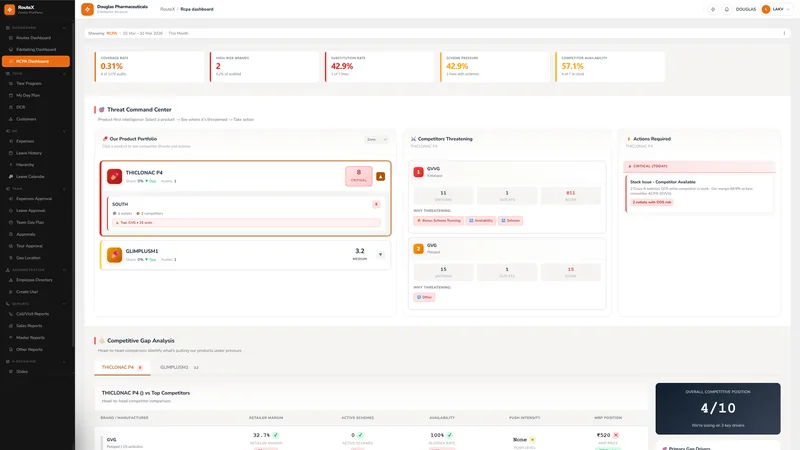
RCPA tracking — prescription intelligence at the chemist level
Zoulte's RCPA tracking tool gives your field team real-time visibility into prescription patterns across every chemist in their territory. Know exactly which doctors are writing which brands — so every sales call is backed by data, not guesswork. Identify conversion opportunities before your competitor does.
Explore Zoulte RCPA Tracking →| Activity | Impact on prescriptions | Zoulte tool |
|---|---|---|
| Relationship building | High | Visit tracking & history |
| Clinical detailing | High | e-Detailing |
| RCPA intelligence | Very High | RCPA tracking |
| Tour & patch planning | Very High | Tour planner |
| A-category doctor prioritisation | Critical | Doctor categorisation with target tracking |
| Stock availability (chemist + stockist) | Critical | Distribution tracking |
| Performance analytics | Critical | Metrics dashboard |
08. Smart tour planning — covering more ground, more effectively
Given that an Indian MR is expected to make 10 to 12 doctor visits per day across a territory of 150 to 200 doctors, tour planning is not an administrative task — it is a performance lever. A poorly planned day means 6 or 7 visits instead of 12. Multiply that across a team of 20 MRs over a month, and thousands of calls are being left on the table.
Smart tour planning, built around the Patch system and the 15-Day Priority Rule, ensures that:
- A-category doctors are always visited in the first 15 days of the month — securing early prescription momentum
- Each day is structured around a geographic Patch — minimising travel, maximising face time
- Visit frequency matches doctor category — high-value doctors get more attention, low-priority ones are not over-served
- No important doctor relationship goes cold due to a missed monthly visit
Tour planning — built around the Indian DCA model
Zoulte's tour planning feature is designed for the realities of the Indian field force. Classify doctors into Gold, Silver and Bronze — or any tier naming your company already uses — set visit targets against each category, and track achievement in real time. Plan visits by priority, monitor daily call achievement against DCA targets, and ensure your top-tier doctors are always seen first. Every day in the field becomes a structured, productive call cycle — not a guessing game.
See Zoulte Tour Planning →09. Product availability — the silent prescription killer
An MR can do everything right — build the relationship, deliver a compelling detail, secure the prescription commitment — and still lose the sale. If the doctor's patient goes to the chemist and the product is not on the shelf, the prescription gets substituted. The competitor wins. And the doctor quietly stops writing your brand.
This is why the chemist and stockist visits built into the Indian MR's daily routine are not secondary tasks — they are as important as the doctor calls. Visiting 5 to 10 chemists per day through RCPA also serves a dual purpose: it collects prescription intelligence and ensures shelf presence. Maintaining 2 to 4 stockist relationships per territory keeps the supply chain tight. When a doctor knows their prescription will always be filled, they prescribe with confidence — and they keep prescribing.
10. Metrics, performance and the manager's view
For a field force manager overseeing 20 MRs across multiple territories, the challenge is clear: how do you know what is actually happening in the field? DCA compliance, A-category doctor coverage, RCPA collection rates, detailing quality — all of these directly affect prescription outcomes, but none of them are visible without the right systems in place.
The best pharma companies in India have moved beyond manual DCR (Daily Call Reports) and Excel-based tracking. They use real-time dashboards that connect field activity to commercial outcomes — allowing managers to coach in the moment, catch problems before they compound, and allocate resources to the territories and MRs that need attention most.
Performance metrics — your field force command centre
Zoulte calculates every metric that matters — DCA achievement, doctor coverage by category, RCPA collection rates, detailing frequency, and territory-level prescription trends. Managers get a real-time view of the entire field force. MRs know exactly where they stand against their targets. Decisions get made on data, not instinct.
Discover Zoulte Analytics →11. The future-ready medical representative
The Indian pharmaceutical market is changing faster than at any point in its history. Doctors have less time, more information, and higher expectations from the MRs they choose to see. Pharma companies are under margin pressure. Competition for shelf space, chemist relationships, and doctor mindshare has never been more intense.
In this environment, the MR who will thrive is not the one who works the longest hours or covers the most doctors. It is the one who combines genuine clinical knowledge with data-driven decision-making and the right digital tools — who knows which 60 doctors to prioritise this month, what the RCPA data says about each of them, and how to make every five-minute detail count.
The companies that invest in equipping their field teams with the right pharma SFA tools and these capabilities will see faster brand adoption, stronger prescription loyalty, and better returns from every rupee spent on field sales. Those that don't will find their MRs working harder and harder for diminishing returns in an increasingly competitive market.
Got questions about Zoulte?
Everything you need to know about how Zoulte works for your field force.
Zoulte allows MRs to log chemist audits directly in the field, in real time, through a simple mobile interface. Because data is captured at the point of visit rather than reconstructed at the end of the day, it is far more reliable than manual reporting.
Where stockist data is also available, it can be used alongside RCPA entries to give managers a fuller picture of prescription and sales trends across the territory.
Explore Zoulte RCPA Tracking →Yes. Zoulte's e-Detailing is fully functional offline — which is essential for MRs working in clinics, hospitals and areas with unreliable connectivity. Presentations load and run smoothly on a tablet without needing an active internet connection.
Data syncs automatically once connectivity is restored, so nothing is lost and managers always have an up-to-date picture of field activity.
See Zoulte e-Detailing →Zoulte's manager dashboard gives real-time visibility into DCA achievement for every MR in the team — by day, by week, and across the full monthly cycle. Critically, the system also validates actual field activity against set targets, so both MRs and managers always know exactly where they stand against the daily call requirement — not just in theory, but against the numbers that were agreed.
Managers can see at a glance which MRs are on track, which are falling behind, and which territories need attention — and because the data is live, they can intervene and coach in the moment rather than discovering problems at the month-end review when it is already too late to act.
Discover Zoulte Analytics →Zoulte allows managers and MRs to classify doctors into tiers — Gold, Silver and Bronze, or any custom naming convention your company already uses. The tour planner and visit tracking tools are built around these categories, ensuring high-priority doctors receive the right visit frequency each month.
Visit history, RCPA data and detailing records are all linked to each doctor profile, giving the MR a complete picture before every call and the manager a clear view of coverage quality across the team.
See Zoulte Tour Planning →Yes. Zoulte is designed to support the full range of Indian pharma territory types — from high-volume General and Acute segments with 180 to 200 doctors, through to focused Specialty territories covering cardiologists, diabetologists and neurologists, and Super-Specialty territories in oncology and nephrology.
Territory structures, doctor lists, visit frequencies and reporting requirements can all be configured to match the segment and the company's specific field force model. Targets can also be set against each category of doctor — Gold, Silver and Bronze or any custom classification — and tracked in real time, so managers always know whether the right doctors are getting the right level of attention across every territory type.
Request a Demo →Zoulte is built to be field-ready from day one. The interface is designed for MRs who are on the move — not for people sitting at a desk — so it is intuitive, fast, and requires minimal training. Most MRs are up and running within their first working day.
Onboarding support is provided, and managers have access to setup tools that make it straightforward to load territory data, doctor lists and product information quickly — so the whole team can hit the ground running together.
Get Started with Zoulte →Give your field force the edge they need
Zoulte brings together RCPA tracking, e-Detailing, tour planning, doctor categorisation, and performance analytics in one platform — built for the realities of the Indian pharmaceutical field force, and ready to scale globally.
Join hundreds of pharma teams already using Zoulte to turn field activity into prescription growth.