Based on field force behaviour patterns observed across Indian pharma teams, 15–20% of visits recorded on manual reporting systems are ghost visits — interactions logged but not meaningfully completed. This is not a discipline problem. It is a data integrity problem — and it compounds silently, territory by territory, month after month.
Every pharma CEO knows their field force has gaps. What very few know is exactly how much those gaps cost — in rupees, per month, per year. Not in vague terms like "lost prescriptions" or "poor coverage" — but in a specific number built from your own inputs. This article gives you three calculators to find that number. The defaults are deliberately conservative. The results may still surprise you.
01. The ghost visit cost — how much is your pharma field force losing?
On a manual reporting system, an MR fills their Daily Call Report from memory at the end of the day — not from the field in real time. This is where ghost visits are born. Not always out of dishonesty — simply because memory-based reporting is inherently unreliable. A doctor who was unavailable becomes a completed call. A three-minute waiting room interaction becomes a full detail visit.
Here is what those ghost visits cost in prescription revenue — using your own numbers. Use the pharma field force ROI calculators below to quantify exactly what ghost visit detection, DCA compliance tracking, and RCPA intelligence gaps are costing your MR productivity — in rupees.
How much are ghost visits costing your field force?
—
—
—
Ghost visit rate fixed at 17.5% midpoint of 15–20%. Competitor switching risk of 50% based on detailing frequency research. All other inputs adjustable.
Calculator 1 shows the scale of the ghost visit problem — how many visits are unverified and what they cost in aggregate. Calculator 2 zooms in on the same problem from a different angle: not all ghost visits are equally costly.
Ghost visits do not distribute evenly across a territory. They cluster on the same 2–4 doctors, month after month — the harder-to-reach clinic, the inconvenient location, the doctor who keeps the MR waiting. These are not random misses. They are systematic relationship gaps — and the cost of losing 2–4 specific doctors is far higher than losing the same number of visits spread randomly.
Calculator 2 puts a rupee value on exactly that cluster.
02. The cluster relationship cost — prescription revenue at risk per MR
The most dangerous consequence of ghost visits is not the aggregate revenue loss — it is what happens to specific doctors who are being quietly dropped from the visit cycle. A doctor missed once is a risk. A doctor missed for two or more consecutive months is a relationship being handed to a competitor.
Adjust the cluster size slider to match what you know — or suspect — about your own field force.
What does losing 2–4 doctors per MR actually cost?
—
—
Competitor switching risk of 50% based on published detailing frequency research. Cluster size default derived from Calculator 1 ghost visit clustering pattern — adjustable to match your field force reality.
03. The RCPA intelligence gap — missed prescription conversion opportunity in India
The first two calculators show what your field force is losing. This one shows what it is failing to gain.
In a typical Indian pharma territory of 150 doctors, a significant proportion are currently prescribing a competitor brand for molecules you also sell. Without RCPA data — collected at the chemist, in real time — your MRs have no way of knowing who they are. They cannot target them. The conversion opportunity is invisible.
Industry experience suggests 25–40% of doctors in a General segment territory are prescribing a competitor brand in your therapy area. With RCPA intelligence, a focused MR can realistically convert 10–15% of those doctors over a 6-month cycle. Without it, that opportunity simply does not exist.
What is the missed conversion opportunity worth?
—
—
—
Competitor prescriber % based on General segment industry experience. Conversion rate is conservative — actual results vary by therapy area, product strength and MR quality.
Your combined opportunity cost
The three calculators above measure three separate but related gaps. This is what they add up to — using your inputs.
* Calculator 1 shows the scale of the ghost visit problem — it provides context for Calculator 2 but is not included in the total to avoid double counting. Calculator 2 measures the relationship-level cost of ghost visits clustering on 2–4 specific doctors per MR. Calculator 3 is an independent opportunity measure. The combined total is Calculator 2 + Calculator 3 — what you are losing from dropped relationships plus what you are failing to gain from invisible competitor prescribers.
"The lost opportunity in a pharma field force is rarely visible. It does not show up as a line item. It shows up as flat territory numbers, a competitor gaining share, and a doctor who quietly stopped writing your brand."
Pharma field force — key concepts explained
Definitions of the terms used in this article and in Indian pharma field force management.
A ghost visit occurs when a medical representative records a doctor visit in the Daily Call Report but the interaction did not actually happen or was extremely brief. Ghost visits typically appear in manual reporting systems where call entries are filled at the end of the day rather than verified in real time.
Based on field force behaviour patterns observed across Indian pharma teams, 15–20% of visits on manual systems are typically ghost visits. On a 100-rep team reporting 10 visits per day, that is approximately 4,375 ghost visits per month — doctor relationships that appear maintained in the system but are not.
DCA (Daily Call Average) refers to the number of doctor visits a medical representative makes per day. Most Indian pharma companies set a target DCA of 10–12 visits per day for General segments, 8–10 for Specialty, and 5–7 for Super-Specialty territories.
Falling short of the DCA target — even by 2–3 visits per day — compounds into thousands of missed interactions per team per month. Real-time DCA tracking with target validation is the only mechanism that makes mid-cycle recovery possible.
RCPA (Retail Chemist Prescription Audit) is the collection of prescription information from retail pharmacies to understand which brands doctors are prescribing in a specific territory. MRs visit 5–10 chemists per day to audit prescriptions dispensed, building a real-time picture of competitor brand activity.
RCPA data makes competitor prescribers visible and targetable — revealing which doctors are writing competitor brands for molecules your MR also promotes, so the right conversion pitch can be delivered to the right doctor.
Pharma companies use Sales Force Automation (SFA) systems to track doctor visits in real time, monitor Daily Call Average against targets, collect RCPA intelligence at the chemist, and give managers live visibility of field force performance.
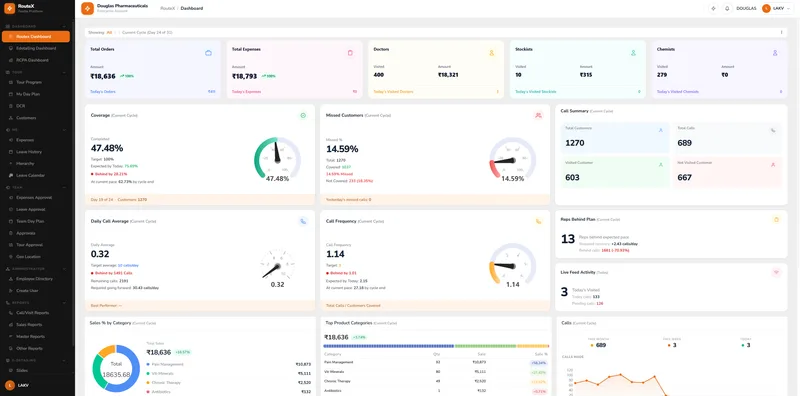
SFA tools like Zoulte RouteX eliminate ghost visits through geo-tagged verification, replace end-of-day manual reporting with real-time data, and give CEOs and Heads of Sales a command centre view of their entire field force — so problems are visible on Day 10, not Day 30.
Ghost visits mean doctors are not being seen as frequently as the reporting system suggests. When the same doctors are missed repeatedly — a pattern called cluster dropping — research shows that 2 consecutive missed visit cycles increases the risk of competitor switching by more than 50%.
The compounding effect is significant: for a 100-rep team at conservative assumptions, ghost visits can put ₹1 crore or more in prescription revenue at risk annually — not from random misses, but from a small cluster of 2–4 doctors per MR being quietly dropped from the visit cycle.
Based on industry experience with Indian pharma field forces transitioning from manual to digital reporting, actual DCA on manual systems typically runs 20–30% below target. An MR targeting 10 calls per day may be making 7–8, with the gap invisible to managers until the month-end review — when it is too late to recover.
Real-time DCA tracking with target validation — as provided by Zoulte RouteX — makes the gap visible on Day 10, giving managers 15+ working days to intervene and guide recovery before the cycle closes.
G. Glossary — Indian pharma field force terms
Key terms used in this article and across Indian pharmaceutical field force management.
A doctor visit logged in the Daily Call Report that did not actually occur or was not a meaningful interaction. Ghost visits are a byproduct of end-of-day manual reporting where entries are filled from memory rather than verified in real time.
The number of doctor visits an MR completes per working day. Standard DCA targets in India: 10–12 for General/Acute segments, 8–10 for Specialty, 5–7 for Super-Specialty. DCA is a primary productivity metric for Indian pharma field forces.
The collection of prescription data from retail chemists to track which doctors are prescribing which brands in a territory. MRs typically visit 5–10 chemists per day as part of the standard Indian pharma daily workflow alongside doctor calls.
Software that automates and tracks field force activities including visit logging, DCA monitoring, RCPA collection, expense management and reporting. SFA tools replace manual WhatsApp and Excel-based systems with real-time digital data.
The full list of doctors assigned to an MR's territory. Standard size in India: 150–180 doctors for General/Acute segments, 100–120 for Specialty, 40–60 for Super-Specialty. The master list defines the MR's monthly call universe.
A geographic sub-area within an MR's territory containing 8–15 doctors within a 2–5km radius. A territory typically has 15–20 patches. An MR covers one patch per day to minimise travel time and maximise face time with doctors.
The classification of doctors in a territory by prescription potential and current performance. Gold doctors (top 50–60) receive 2–3 visits per month. Silver doctors receive one monthly visit. Bronze doctors are monitored via RCPA for upgrade potential. Category names vary by company.
A pharmaceutical wholesaler or distributor who holds stock of a company's products and supplies retail chemists in a territory. MRs typically maintain relationships with 2–4 stockists per territory to ensure product availability when doctors prescribe.
The daily activity report submitted by an MR recording doctor visits, samples distributed, RCPA data and other field activities. On manual systems, DCRs are typically filled at end of day from memory — the primary source of ghost visit risk. SFA tools replace DCRs with real-time field logging.
Ready to close these gaps?
Zoulte RouteX gives your field force geo-tagged visit verification, real-time DCA tracking with target validation, and RCPA intelligence collected at the chemist — in one platform built for the Indian field force.
Operate. Optimise. Dominate.